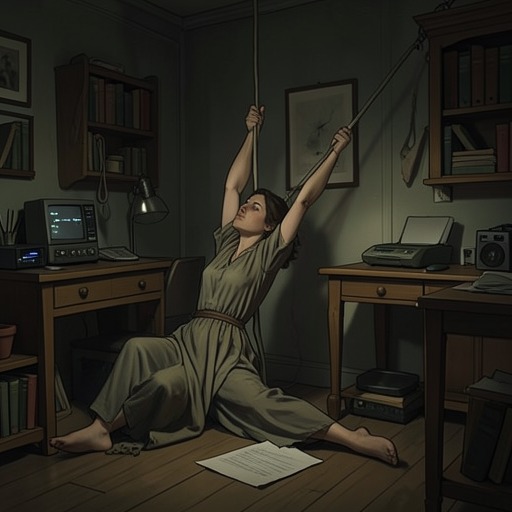
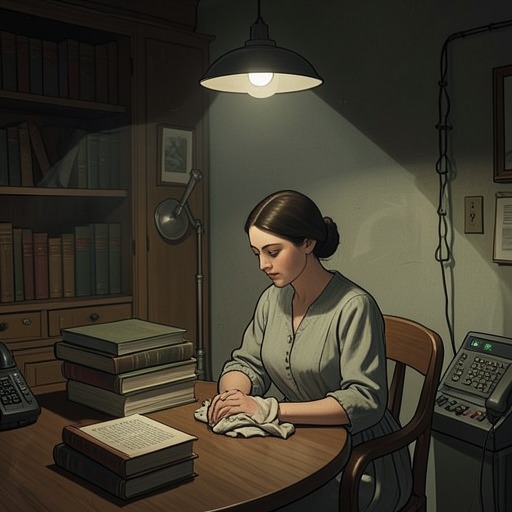
Hanna Schmitz's imprisonment
The ReaderHanna Schmitz’s imprisonment lasts eighteen years, a period that changes her daily life without resolving her past or preparing her easily for life outside prison. Its terms are conveyed through sewing-shop work, correspondence and recorded readings, her education in literacy, and the prison’s gradual preparation for release. The anticipated transition ends with her death on the night before Michael Berg is due to collect her, leaving the sentence’s conclusion inseparable from the question of whether a return to the outside world was possible for her.
Sentence and the prospect of release
The duration of the sentence gives the imprisonment its defining shape. Michael’s record of the books he read for Hanna shows that he sent the first package in the eighth year of her sentence and the last in the eighteenth. In that final year, her plea for clemency was granted. After eighteen years, the prison warden expected the parole board to approve her appeal and anticipated that Hanna would be released shortly thereafter.
The warden’s preparations made clear that release would not simply reverse confinement. Hanna was in excellent health and had developed considerable skill in the prison sewing shop, but finding a job at her age was expected to be difficult. The warden asked Michael to help arrange a small apartment and work, visit Hanna, invite her to his home during her first weeks and months outside, and connect her with community and educational programs. The concern was practical: after so long in prison, going into town, shopping, dealing with authorities, or visiting a restaurant could be difficult, and doing these things with another person would help.
Michael arranged an inexpensive apartment through friends and found a possible job with a Greek tailor whose sister planned to return to Greece. He also looked into social and educational services. Yet he postponed visiting Hanna, fearing that the distance maintained by tapes and notes could not survive face-to-face contact or the history between them. The year passed without his visit. When the pardon and release were finally confirmed, the warden called to say Hanna would be out in a week. Michael’s practical preparations had advanced further than his willingness to meet her.
Prison routines and standing among other women
The warden described Hanna’s long confinement as a life organized almost like a convent: she seemed to have accepted the institution’s routines voluntarily, and monotonous work appeared to function for her like meditation. Other women respected her. She was friendly but reserved, and had enough authority that they sought her advice when disputes arose; when she intervened, they accepted her decision.
Her circumstances changed in the last few years. Hanna had previously cared for herself meticulously and remained slender despite her strong build. Later she ate much more and washed less, gaining weight and neglecting her appearance. The warden did not describe this simply as unhappiness or surrender. Rather, Hanna seemed to redefine her place in the prison, withdrawing further from the company and visibility that had once been part of her life. This retreat no longer impressed the other women, but it was a change in how she inhabited confinement, not merely a decline in her standing.
The warden’s account makes the prison both a restrictive institution and the setting in which Hanna had formed habits, work, authority, and a social position. By the time release approached, the prison was not only where she had spent eighteen years; it was also a familiar structure from which everyday outside tasks might feel newly difficult. The prospect of freedom therefore brought its own need for accompaniment and support.
Reading, writing, and contact with Michael
Michael’s recordings created a connection across the separation of prison, but he kept that connection deliberately narrow. He read aloud the title, author, and text, without personal remarks, questions about Hanna, or news about himself. His first package, sent after he had recorded the Odyssey and then stories by Schnitzler and Chekhov, included a cassette player and tapes arranged from Chekhov to Schnitzler to Homer. Over the years, he read both books he wanted to read at the time and works he already loved, including books by Keller and Fontane and poems by Heine and Mörike.
In the fourth year of this word-driven, wordless contact, Hanna sent a short note thanking him and saying that she had liked the last story. The note was written in forceful, uneven handwriting; the pressure of the pen carried through the paper, and forming the letters appeared to require effort. Michael understood the message as proof that she had learned to write. He had studied the everyday dependence created by illiteracy, including the difficulty of finding one’s way, locating an address, or choosing a meal, and the energy required to conceal an inability to read and write. Hanna’s literacy represented a move from dependence toward independence, though the labor visible in her writing also made its late arrival poignant to him.
More notes followed, usually only a few lines long. Hanna thanked him, requested or rejected authors, commented on literature, or mentioned prison and the world visible from there: forsythia flowering in the yard, summer storms, or birds gathering to fly south. Her literary judgments could be unexpectedly precise, and her brief observations sometimes made Michael notice the natural changes she described. The correspondence did not become a conventional exchange of personal confidences, but it gave Hanna a means to express preferences and perceptions in her own writing.
Release and death
When Michael finally visited, the prison warden showed him Hanna’s cell as she had lived in it, explaining that Hanna had not packed. Alongside ordinary furniture, the shelf held books, an alarm clock, a stuffed bear, mugs, tea tins, the cassette machine, and two lower shelves of Michael’s recordings. The tapes had accumulated as a material record of their long, restrained connection. The warden noted that not all of them were present.
Hanna left no direct message for Michael. Her written instructions, which the warden read to him, directed that the money in the lavender tea tin and 7,000 marks in the bank be sent to the daughter who had survived the church fire with her mother, leaving that woman to decide what to do with it. The instruction connected Hanna’s remaining resources to someone affected by the past she had shared with Michael, while offering him only a greeting transmitted through the warden.
The warden said Hanna had not explained why she intended to kill herself. She described Hanna’s death as a blow and expressed anger at both Hanna and Michael, who was supposed to collect her the following morning. The death thus came at the precise threshold between imprisonment and release: the practical arrangements for an outside life were in place, but Hanna did not enter it. Her eighteen-year sentence ended not in a return to ordinary life but in a final absence, leaving the reasons for her suicide unstated.
Significance of the imprisonment
Hanna’s imprisonment cannot be reduced either to the formal fact of an eighteen-year sentence or to a simple story of rehabilitation. The prison gave structure to her days and a place within a community of women; it also provided work and the conditions in which she learned to read and write. Her literacy enabled communication and greater independence, while the warden’s preparations showed that skills acquired inside did not erase the difficulties of resuming life outside after so long.
The contrast between confinement and the anticipated release is sharpened by Michael’s role. He helps make a home and job possible, yet avoids the visit that might have turned those arrangements into direct companionship. Their tapes and notes establish contact while keeping personal disclosure at a distance. The planned release therefore exposes the limits of communication that has endured for years without becoming an ordinary face-to-face relationship.
The ending gives the imprisonment a tragic, unresolved boundary. Hanna’s cell preserves the objects of her prison life, including the recordings and the tea tin that held money for another person; the release plan remains unfinished, while her final instructions reach Michael only through the warden. The account presents confinement as a period of labor, learning, adaptation, and restricted connection, but it does not claim that these changes could settle Hanna’s past or make the transition outside possible.